Days 22-37: Nepal | Manaslu Circuit Trek & Kathmandu
- Amelia Mazloom
- Jun 15
- 17 min read

The Skinny - if you're just here for the highlights (this is a longer one): We spent 11 days trekking Nepal's Manaslu (the 8th tallest mountain in the world) Circuit, hiking about 96 miles and 29,000 vertical feet through remote Himalayan villages, monasteries, yak pastures, and some of the most spectacular mountain scenery either of us have ever seen. Along the way we survived questionable roads, endless tea house menus, culture shock, altitude, a truly astonishing amount of donkey poop, and our guide Chandroa's increasingly concerning inability to keep up with his clients.
Highlights included visiting a monastery during a rare prayer service, watching avalanches thunder down distant mountains, laying eyes on endless 18-23,000+ peaks, making friends from around the world, reaching 15,200 feet below Manaslu Base Camp, crossing Larke Pass at 16,950 feet, and Sean immediately deciding that wasn't enough altitude and sprinting to 17,000 feet.
After the trek, we returned to Kathmandu for a few days and enjoyed massages, counterfeit outdoor gear shopping, city exploration, monkey sightings, Hindu cremation grounds viewing, and a crash course in Nepalese history, religion, and culture.
Nepal was challenging-- in more ways than one, beautiful, chaotic, welcoming, humbling, and unlike anywhere we've ever been.
Scroll down for pictures (and settle in).
Getting Oriented: Life on the Manaslu Circuit
We had a warm and shocking late-night arrival to Kathmandu. Our trekking company picked us up from the airport with marigold flower necklaces and brought us to our hotel. The shocking part was the drive. It was a total free-for-all like nothing either of us have ever seen. As Sean described it, “organized chaos” but there appeared no pattern of organization, just that we didn't witness any crashes.
Everyone we met was absolutely lovely and the outpouring of hospitality continued in the morning with a fresh breakfast and the entire staff at our service and wishing us luck on our trek. It was not lost on me that we were beginning this adventure on my Gram’s birthday, and I felt her proud and protective presence. Not only that, but May 8 was also the 70 year anniversary of the first ever summit of Manaslu by a Japanese team and Sherpa in 1956. Pretty cool.
We met our guide, Chandroa, who walked us to the Himalayan Masters office where we were given a detailed day-by-day briefing and storage space for the rest of our stuff. In retrospect, his lack of enthusiasm, especially contrasted with our abundance of it (and that of all the other guides we had met), was our first yellow flag. But at the time we were too excited to care.
We set out toward our first stop on the trek, Machha Khola. Leaving Kathmandu, we passed colorful weddings, roadside fruit stands, and mango and banana trees everywhere. At first I couldn't figure out where all the produce was coming from, but as the city thinned out, I noticed gardens and small farms tucked between nearly every cluster of homes.
We took a "shortcut" to meet up with the "highway" that is supposed to someday connect India, Nepal, and China. As Depac put it, Nepal is "200 years behind," and Sean and I agreed it may take another 200 years to finish this road. Progress is slow and largely undone each year when the monsoon arrives. Though only 160 km (100 miles) from Kathmandu, Machha Khola was a seven-hour drive. The first 120 km were paved, but narrow, winding, and heavily dependent on aggressive horn usage around blind corners. The final 40 km were a dirt road carved into the side of a cliff. Honestly, I think the walking trail up Roy's Peak in New Zealand was better suited for vehicles.
At lunch we had our first dal bhat, Nepal's national dish: lentil soup, rice, curries, vegetables, and pickles served together on a metal platter. It was delicious and properly spicy– the kind that is enjoyable while eating but memorable afterward. What surprised us was how it was eaten. Although we were given silverware, our driver and Chandroa ate with their hands, which is completely normal in Nepal but caught us off guard. Rice and curry had never occurred to us as finger food, particularly when the curry in question was trying to remove a layer of skin from your mouth. I suppose a ramification of colonization that did not make its way to Nepal as the Nepalese impressively held up against British attempts to colonize.
Anyway, we arrived in Machha Khola (which is at 2851 ft.; actually closer to sea level than Kathmandu– part of acclimatizing) where we stayed at our first “tea house." The trek wanders through a series of tiny villages ranging anywhere from a handful of buildings to perhaps fifty, many of which are tea houses– simple family-run accommodations that function as a combination hostel, restaurant, and community gathering place.
At our first tea house, the menu seemed enormous and exciting. By day three, we realized every tea house in the Himalayas shares the exact same menu. We rotated between dal bhat, fried rice, noodles, soup, eggs, and momo (handmade Nepalese dumplings, which were thrilling at first and gradually became less so). Aside from eggs, we stuck to a vegetarian diet to avoid food poisoning, which thankfully worked. Lemon-ginger-honey tea was our evening reward, and as vegetables became increasingly scarce at higher elevations, we were grateful for the sliced apple Chandroa handed us each night.
Chandroa was a stark contrast to most of the other guides on the trail, who tended to be young, lean and lanky mountain goats. Looking back through my journal, it's funny to see my opinion evolve. On the first day, I noted that he seemed a little slow but figured it would be fine. By the end, nearly every entry involved waiting for him somewhere along the trail. He kept us safe and we avoided food poisoning, but that bare minimum was the extent of his guidance. A lesson we learned from this experience (and taking a note from our friend DiDi) is if you are going to spend more than a couple of days with a guide in the wilderness, a compatibility interview is completely within bounds.
Every other group on the trek, with the exception of one sweet french guy and our friend DiDi (who did eventually share some of her load with her guide) used a porter. We didn’t realize this was the standard, but wouldn’t have changed a thing. We had everything we needed and the weight only felt like a burden when we were able to ditch it and enjoy pack-free trekking.
Because we were trekking outside peak season, we lucked out and had private rooms every night. In October, most of these tea houses are packed wall-to-wall with trekkers.
Our days on the trek were all very simple and their bones very similar. Each day we woke up around 6 am, had breakfast and started trekking. We would stop for lunch in one village, then continue on to the next, where we'd spend the night. Our down time, less abundant than expected, was spent hand washing laundry, filtering water, stretching, and finally, reading. These small, time-consuming chores have a way of making you appreciate modern efficiencies. As we climbed higher, the culture increasingly reflected the region's proximity to Tibet and historic trading relationship. Prayer wheels, monasteries, mani stones, and Tibetan Buddhist traditions became an ever-present part of daily life.
An unforeseen delight was being on the trail at the same time and daily pace as many other groups. We got to know lots of familiar faces and had many interesting conversations. By the end, we felt particularly close kinships with a gal from the Netherlands that we met on the second day, and a father and two sons from Vancouver with whom we spent most of the second half of the trek. We met more hikers from New Zealand, Australia, Netherlands, Doha, France, and even some vagabonds– one of which was born in Utica. And everyone had such interesting stories and backgrounds. Frequently along the trail, strangers became temporary companions for a few miles before drifting apart again.
We were very blessed with exceptional weather that was relatively moderate, clear enough, and most importantly, not rainy. That was a risk this close to Monsoon season. Every single day was indescribably beautiful, and somehow only got better. During our briefing, we were told that during the first few days while gaining altitude, we might think ‘why am I here’ and it's not much to look at. We disagreed fervently, though once we gained altitude, we fully understood what he meant.
All in all, we hiked 95.6 miles and 28,675 vertical feet. This was far more than either of us have ever come close to completing over the course of 11 days, and something we learned from this experience is that our bodies are much stronger and more adaptable than we give them credit for. We would have expected to be crumbling with soreness, at least by the end, but honestly we hardly ever felt the strain. Some credit is owed to our diligent daily stretching efforts. But we will return to Utah with a broadened perspective on operating in the mountains.
Trek Days 2-4 (Day 2: 3,166 ft. & 11.87 miles | Day 3: 3,894 ft & 13.12 miles| Day 4: 4,426 ft & 10.61 miles)
The trail followed the river through evermore dramatic terrain. We passed waterfalls, butterflies, wild nettle and eventually laid eyes on our first truly enormous Himalayan peaks– the most massive mountains we had ever seen by far. There was also wild hemp growing everywhere. No wonder they’re so enlightened around here… Ganja they call it… but these days it's just the male hemp plant, the female flower producing marijuana plant is illegal to grow and rare to find wild these days.
The first night came with some run of the mill culture shock. Nepal felt very different from anywhere either of us had traveled before, and the adjustment was abrupt. Whenever I felt myself getting overwhelmed, I kept returning to Anthony Bourdain’s line: "Move, as far as you can, as much as you can. Walk in someone else's shoes. Open your mind. Move."
Not every observation was picturesque. One thing nobody prepared me for was the quantity of donkey and yak poop covering the trail. It was fucking everywhere. I ride horses and generally consider myself tolerant of manure, but these were rancid, inescapable, and made worse by the various swarms of accompanying bugs. It briefly sent me over the edge, briefly pushed me to my limits. Thankfully, like most of life’s problems, this annoyance shrank after a (very) cold plunge in a Himalayan river.
Happy Mother’s Day Moms<3 !!

Trek Day 5 (3,930 ft & 9.25 miles)
We woke to an incredible chorus of birdsong. The morning mountain views were spectacular and accompanied with the smell of burning incense. I ended up playing "medicine woman" for part of the day, helping with blisters and nausea.
We had our first view of Manaslu in a fortuitous parting of clouds, and made a short detour to visit a monastery which happened to be in the middle of a prayer service that only occurs twice a year. The leading monk had walked there all the way from Kathmandu to perform the two-day service. The temple itself was incredibly ornate and colorful, as is typical of Tibetan Buddhism.
We continued toward our next town through beautiful moss-covered forest, following a crystal clear creek. Along the way, we first met our Vancouver friends. In Shyala, we took a hot bucket shower…an experience in itself. Once the sun disappeared, the temperature dropped quickly so we all gathered around a fire stove in the dining room and spent hours chatting. One of the Canadians had completed a Vipassana retreat and was fascinating to talk with ahead of our next stop. DiDi was also staying there. Unfortunately, she ordered pizza for dinner and became quite sick afterward…
Trek Day 6 (2,546 ft & 11.17 miles)
Excellent sunrise views of Manaslu before the clouds rolled in. I had a small headache and low energy that I chalked up to dehydration, despite my diligent hydration efforts. We set out for Pungyen Monastery, a side trip skipped by many due to the cloudy conditions, but we had a nagging feeling it would clear. The gamble paid off and the views were spectacular. We saw Manaslu, an avalanche, glacier runoff, wildflowers, yak-filled valley and a 200 year old Monastery.
On the hike out I started feeling better, but by the return trip I crashed again. At this point Sean was feeling off as well. Eventually I realized the problem was not dehydration but a serious calorie deficit. Back at the tea house I loaded up on two lunches and a snickers bar, and once we started moving again towards the next town, both of us felt noticeably better.
Arriving in Samagaon was surreal. It was difficult to believe that people permanently live at this altitude in such a remote environment. The homes honestly looked like the stable from my mom’s very humble nativity scene, and most of the town– women especially– passed their days collecting rock slabs and then hammering them into smaller stones. They used this for cement filler. The sound of the hammering never ceased.


Trek Day 7 (3,783 ft & 8.25 miles)
The trail to Manaslu Base Camp had recently been improved using tourist-fee funding, boasting long sections of impressive stone steps. Along the way we passed more yaks, waterfalls, glacier runoff, wildflowers, and the hallmark turquoise alpine lake.
We passed older trekkers still grinding their way up the mountain on a trip with their adult children, which was inspiring. Chandroa was 20 minutes behind us the whole day. As we climbed higher, fueled by two snickers bars, we spotted two golden eagles soaring overhead and reached several milestones. First came 13,500 feet– my highest elevation ever. After that, we hit Sean's personal altitude record at 14,500 and the moment we crossed that threshold, a massive avalanche thundered in the visible distance to our left. Somehow, I caught this all on video. We heard avalanche after avalanche echoing across the valley throughout the rest of the hike.
Eventually we reached roughly 15,200 feet, only 500–600 vertical feet below Manaslu Base Camp. Clouds were thickening, visibility was deteriorating, and our guide was waiting well below us, unable to continue higher. We made the smart decision to turn around. Honestly, neither of us cared much about the actual base camp. The views were already spectacular, we felt strong, energized, and reaching 15,200 ft exceeded anything we'd done before. A casualty of the day was that I sadly lost my sunglasses, but I was shockingly able to purchase a pair of very speedy shades from a little shop in town.
Trek Day 8 (1,302 ft & 4.47 miles)
Sean got us up before dawn for the clearest views we'd had of Manaslu all trip. The mountain stood completely unobstructed as we made the short walk to Samdo (12,713 ft). We had originally planned to spend an extra day here exploring toward the Tibetan border, but with Chandroa’s increasing decline, we ultimately decided to keep moving and finish the trek alongside our new friends.
Once we arrived, we settled into a large teahouse with a wonderful sunroom where we read for hours, stretched, and even fit in a short meditation session. Not everything was picturesque though as we discovered a flea on our bed…The social dynamics among trekkers were becoming more noticeable too. One group in particular was beginning to wear on our patience.
Trek Day 9 (2,149 ft & 4.03 miles)
We woke to a completely overcast morning, but the Canadian dad, Guiddian, confidently predicted the clouds would burn off. He was right. As we set off for Dharmasala (14633 ft), the highest place we would sleep, we were in a state of pure awe at the surrounding Himalayas. The scenery was spectacular. We saw loads of marmots, and other trekkers even spotted some standing up and "boxing" each other. The landscape was evermore stripped down. Dharmasala itself was the simplest and most rugged place we'd stayed so far– windy, cold, and exposed with nothing but 3 very simple tea houses to offer.
We arrived around 11 a.m. and quickly settled into our “room” inside which were just a few small sleeping pads on the bare ground. We spent the afternoon reading, chatting, and drinking water. As evening settled in, a sea of clouds filled the valleys below us. The twilight glow spread across the mountains filling us with a sense of deep calm before a major adventure.

Crossing Day!! (2,595 ft & 10.69 miles)
Crossing day began long before sunrise. Because we were lucky enough to have a new moon, the sky was darker than anything we'd seen on the trek, most of which was spent under cloudy nights, so finally seeing the stars, the best I have ever seen, was such a gift. We hardly slept, and Sean got up repeatedly to step outside and stare at the sky. The Milky Way stretched overhead along with shooting stars, satellites and stars as far as we could see. It felt like being on the inside of a snowglobe.
I woke up feeling oddly thirsty. After a quick breakfast, we set out at 4am . The climb began immediately and we gained elevation quickly. It wasn’t long before we stripped off our layers and wove around slower groups to create some breathing room. As dawn arrived, the mountains slowly lit up around us. The sunrise behind Larke Peak cast a soft glow across the landscape that was gentler than the dramatic alpine glow I was accustomed to.
We both felt strong, with only minor headaches but very energized, right up to 16,000 ft. Not long afterward, I started to feel nauseous. The feeling began subtly but intensified quickly. I eventually resigned to try a few remedies from my med kit, but nothing seemed to help. As we climbed higher, the nausea came in relentless waves. The sensation reminded me of the worst hangover imaginable and at one point I even found myself irrationally swearing off alcohol forever (I hadn’t had a drink in weeks).
I was still able to appreciate the breathtaking beauty around me. Conditions were crystal clear and the scenery was among the most spectacular I had ever seen. Just when I thought we'd reached the top, the trail continued climbing to the true high point at 16,950 ft(!!) From here Sean, of course still full of energy, asked if he could sprint up a nearby bump and tag 17,000 feet. Naturally, he threw down his pack and did it.
After what felt like an eternity of just focusing on my next step, we finally caught sight of the town Bimtang (11,778 ft). The view was stunning. Looking down toward the village, I initially thought I was seeing the mountains surrounding it. Then I realized those weren't even the main peaks. They were merely the lower ⅓ below snowline sections of white capped mountains that continued rising far above, blending with the clouds. The scale of everything was hard to comprehend.
When we arrived at our tea house, I took a short nap and woke up feeling completely normal. How frustrating! With the pass finally behind us, we celebrated in a very glamorous way: body wipes. At this point, we were both looking forward to leaving the tea-house circuit behind and getting clean!
We gathered once more around the fire with our Canadian friends, their sweet guide, and DiDi, who had struggled badly during the crossing and twice reached a point where she said felt she had absolutely nothing left to give. Hearing that resonated with me, and I thought, there is something wonderful about being able to experience reaching your limit, and discovering out of absolute necessity that your reserves go deeper than you could’ve imagined.
Trek Day 11 (866 ft & 11.87 miles)
The morning greeted us with clear skies and beautiful mountain views for our final day on the trail. Not long after setting out, we passed a massive herd of goats moving through the forest. A last glimpse of the rhythms of mountain life before returning to the outside world. We spent the morning walking with the Canadians and said our farewells before parting for lunch. Saw a yellow butterfly-- hi Giddo :) From there, we continued to Jagat, where the walking ended and a terrifying three-hour drive to Besishahar began. We wound through endless hairpin turns, stopping occasionally at checkpoints and scenic overlooks. As we descended into the Annapurna region, the world became noticeably busier.


Back to Civilization... More or Less
The following morning we boarded the 8am tourist bus to Kathmandu. The ride was roughly eight hour, including a somewhat nauseating lunch stop, was surprisingly pleasant. Our parting with Chandroa was all around very awkward. He gave Sean a limp, melancholy handshake, we tipped him, and dipped. Then came one of the great luxuries of modern civilization: the Fairfield Inn. We cleaned up and cheersed celebratory beers. I have never been more grateful for a real shower.
That evening we walked over to the neighboring Aloft hotel for dinner on their top floor, which offered up cool city views, cocktails that incorporated local Nepalese flavors, and live musicians playing traditional drums and wooden flute. After weeks of trekking food, the meal was decadent: corn dumplings, a mezze platter, pork tacos. Both the Fairfield and Aloft– usually very basic accommodations back home– were very swanky, and not just because we had come from tea house living. The staff were over-the-top accommodating and the food was great.
Kathmandu
The timing was such that we ended up with several days in Kathmandu. The first day, we thanked our bodies for all their hard work with a spa day. The massages were hard-earned, and we quickly realized how much we missed the sauna.
We stayed in Thamel, the touristy district of Kathmandu. Here, the chaotic streets are densely lined with souvenir shops selling counterfeit gear, cashmere and wool goods, and other Nepal inspired trinkets (mostly junk). We explored the maze of stores and picked up a few things. We took advantage of the Aloft hotel dinner buffet each night and enjoyed lunch at our hotel. After successfully avoiding food poisoning for the whole trek, and having eaten our fair share of very local cuisine, we were happy with Marriott food.
We took a city tour. Our wonderful guide Asmi explained Nepal's recent political unrest. Her version of events mixed tiktok with protest movements, corruption scandals, government violence, and discoveries of hidden wealth. It was fascinating to hear how ordinary Nepalis understood recent political history and how proud many seemed to be of the changes underway.
Our first destination was the place tourists know simply as Monkey Temple. The actual name, Swayambhunath, may be harder to pronounce, but the nickname is impossible to forget. Perched above Kathmandu, the complex is tied to one of the valley's foundational myths: The Kathmandu Valley was once a vast lake. The bodhisattva Manjushri, having received a vision of a sacred lotus growing from its waters, traveled to the valley and drained the lake, making the land habitable. At the center of the hilltop stood a massive Buddhist stupa that pilgrims circled while praying, as well as Hindu shrines, reflecting the blending of traditions and respectful coexistence that seems to characterize so much of Nepal. But the monkeys stole the show. They were everywhere. Because it was mating season, newborn monkeys were scattered throughout the complex, clinging to their mothers and tumbling around in tiny, awkward bundles.
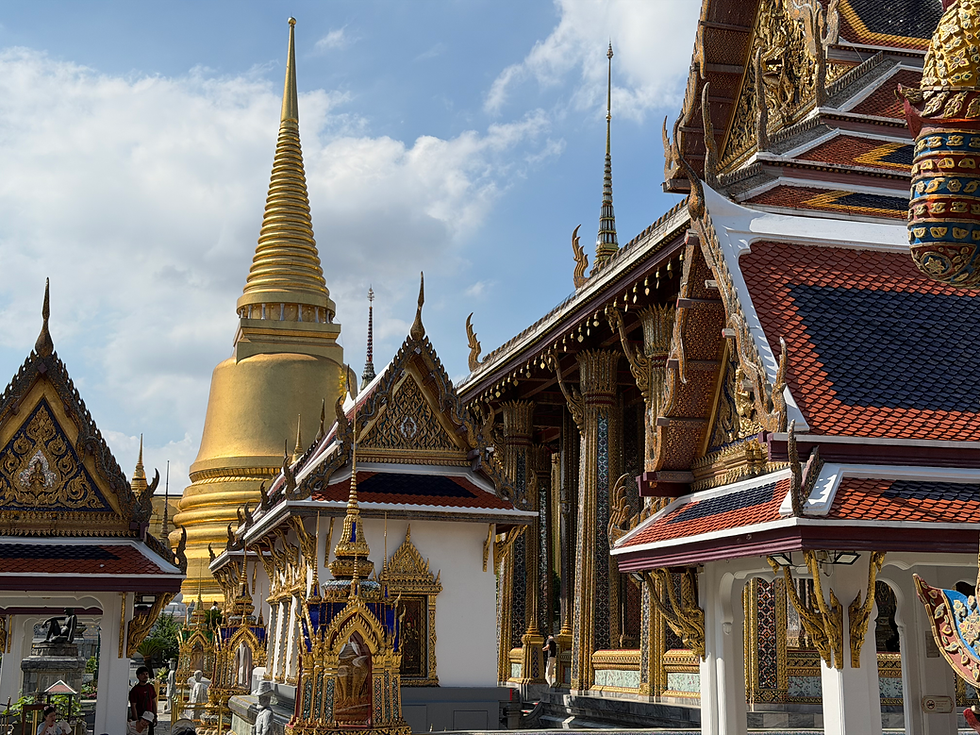
Next we visited Patan, Kathmandu's historic arts district. Compared with the chaotic energy of central Kathmandu, Patan felt refined, peaceful and affluent. Historically it was home to Nepal's royal family, and considering the destruction apparently caused by the 2015 earthquake, the restoration work was remarkable. If it weren't for the before-and-after photographs, we would never have known anything happened. Within the palace, many of the doorways were intentionally tiny so that inhabitants must bow their heads to enter in a gesture of respect toward the gods, but the design also served a defensive purpose by forcing potential attackers into a vulnerable position. Inside were exhibits covering Buddhism, Hinduism, Nepalese history, and royal life. The central square was bordered by intricately carved lattice windows from which women could watch daily life while remaining appropriately unseen. It was interesting to learn that the multi-tiered pagoda style architecture many people associate with East Asia originated in Nepal and spread beyond its borders to leave a lasting mark on China and Tibet.
The next stop was far more confronting. We visited one of Kathmandu's major Hindu cremation sites along the river. Our guide explained the rituals surrounding death and cremation: the body is washed and purified on the riverbank, and cremated as quickly as possible after death. The ashes are then returned to the river, helping release the soul from the physical world. When we arrived, we stood across the river watching several fires burn. At first we assumed preparations were still underway. Only later did we realize the cremations were already in progress. I was surprised that there was almost no smell beyond the burning wood and palm leaves. The reality was far less graphic than my imagination had prepared me for, but the experience was unsettling nonetheless.
At this same site stood one of Nepal's most important temples dedicated to Shiva. The entire area revolved around symbols of fertility, creation, and rebirth, an interesting reminder that the site was ultimately as much about transition as it was about death. Trees around the temple were even carved to look phallic. Our guide explained that millions of pilgrims visit during Shiva festivals each year, transforming the temple grounds into one of the country's largest religious gatherings, which is always celebrated with a lot of Ganja.
One of the day's amusing discoveries was learning that Nepal operates on its own calendar system. While the rest of the world was in 2026, Nepal was already in the year 2083… kinda.


Overall thoughts on Nepal
Nepal was a wonderful reminder that the lows are rarely what we remember when traveling to new and unfamiliar places. While the Indian-style "open air" toilets were certainly an adjustment, they quickly faded into the background beside the peace of the trail, the generosity of strangers, and the sheer awe of waking up each morning surrounded by some of the most spectacular mountains on earth. And the simple lifestyle was a perfect warm-up for what awaited us at our next stop, the Vipassana retreat in India... stay tuned.



Comments